How to choose a reasonable rotary flash dryer? Binda Drying has provided you with a calculation formula for reference only. Please feel free to discuss it in detail with our technical personnel!
Step 1: Calculate the amount of dehydration (two algorithms)
Condition: The initial moisture content of the material is 85%; The final moisture content of the finished product is 12%; The output is 1000kg/h; The processing capacity is 5866.7kg/h
Processing capacity=output+dehydration volume
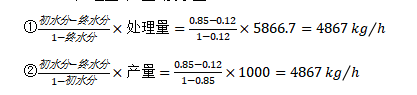
Step 2: Calculate the required heat Q0 for each device
Conditions: The ambient temperature is 10 ℃, the inlet air temperature is 300 ℃, the material temperature is 60 ℃, the air temperature (exhaust temperature) after the drying section is 70 ℃, the latent heat of evaporation of water is 545kcal/kg, the specific heat of the material is 0.38kcal/kg ·℃, and the specific heat of the air is 0.24 kcal/kg.
Regarding the latent heat of water: the latent heat of evaporation of water at 100 ℃ is 540 kcal/kg, and the latent heat of evaporation of water at 80 ℃ is 549 kcal/kg. The material itself also has temperature, so it is generally taken as 550 kcal/kg.
Assumption: Q1: Heat required for evaporating water; Q2: Heat absorbed by the material; Q3: Heat carried away by the air; Q4: The amount of equipment absorption and heat loss, with an air volume of G (kg/h)
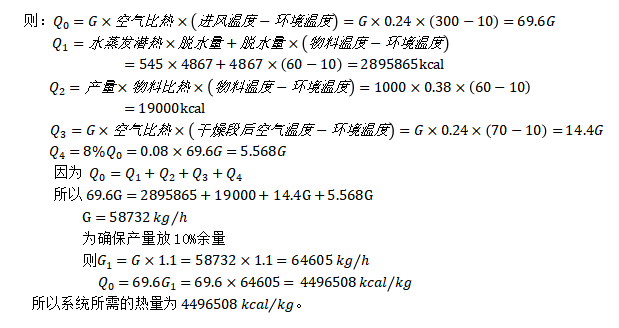
Step 3: Calculate the air volume
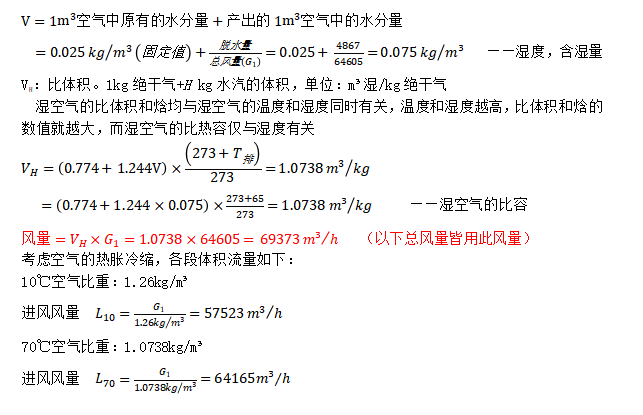
Step 4: Fan Calculation
Fan power: Take the resistance drop of each section as follows:
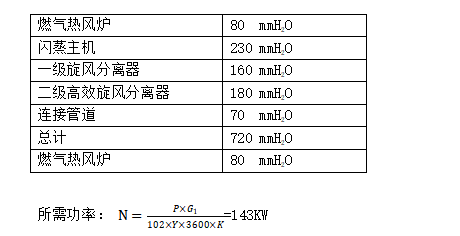
(Y is the fan efficiency, taken as 68%, K is the safety factor taken as 1.3, P is the wind pressure, G1 is the air weight)
Induced draft fan: Find the model based on the calculated power, and then determine the model based on the air volume. Generally, choose 9-26
Blower: Select the model based on the air volume of the induced draft fan, total equipment air pressure, and generally choose 4-72
Step 5: Cyclone Calculation
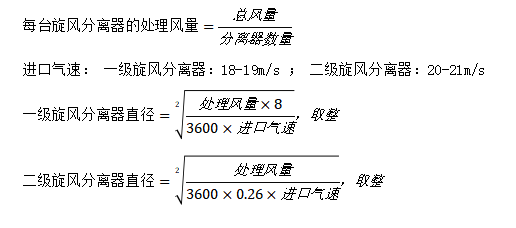
Step 6: Pipeline selection
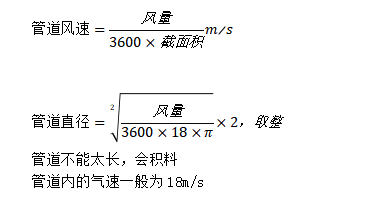
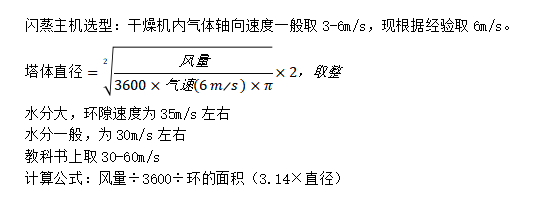
Step 7: Host selection