

Product Overview :
The secondary steam of a certain effect of the evaporator cannot be directly used as the heat source of this effect, but can only be used as the heat source of the secondary effect or several secondary effects. As a heat source for this effect, additional energy must be provided to increase its temperature (pressure). The steam jet pump can only compress a portion of the secondary steam, while the MVR evaporator can compress all the secondary steam in the evaporator.
Introduction to Industrial Wastewater Evaporator Products
1、Brief introduction
Industrial wastewater evaporator (MVR), abbreviated as MVR, is an energy-saving technology that utilizes the energy of secondary steam generated by itself to reduce the demand for external energy. As early as the 1960s, Germany and France had successfully applied this technology to fields such as chemical engineering, food, papermaking, pharmaceuticals, seawater desalination, and wastewater treatment.
2、 Working principle
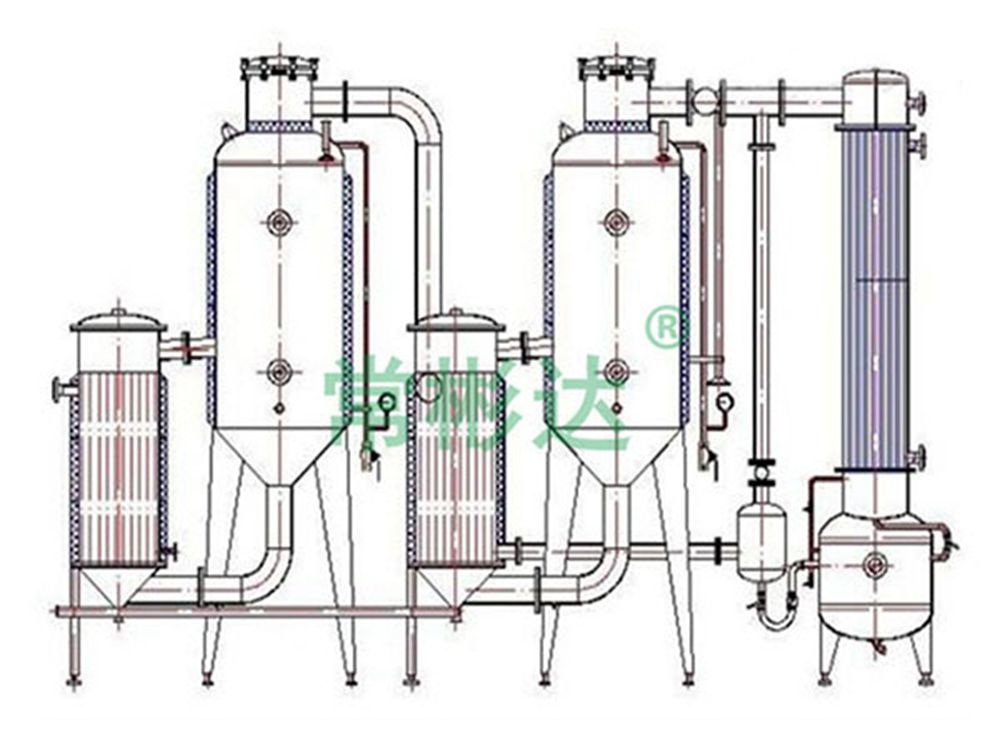
The secondary steam of a certain effect of the evaporator cannot be directly used as the heat source of this effect, but can only be used as the heat source of the secondary effect or several secondary effects. As a heat source for this effect, additional energy must be provided to increase its temperature (pressure). The steam jet pump can only compress a portion of the secondary steam, while the MVR evaporator can compress all the secondary steam in the evaporator. The working process of MVR evaporator is that the low-temperature steam is compressed by the compressor, the temperature and pressure increase, the enthalpy increases, and then enters the heat exchanger for condensation to fully utilize the latent heat of the steam. Except for starting the car, there is no need to generate steam during the entire evaporation process.
3、 Product advantages
The evaporation equipment is compact, occupies a small area, and requires minimal space. It can also eliminate the need for a cooling system. For existing factories that require expansion of evaporation equipment but lack steam and water supply capacity, as well as insufficient space, especially in situations where low-temperature evaporation requires condensation of chilled water, both investment savings and good energy-saving effects can be achieved.
1. Low unit energy consumption
2. Due to the low temperature difference, the evaporation of the product is mild
3. Due to the commonly used single effect, the product has a short residence time
4. Simple process and strong practicality
5. Excellent partial load operation characteristics
6. Low operating cost
4、 Technical features
1. Low energy consumption and low operating costs;
2. Small footprint;
3. Insufficient supporting facilities for public works and low total investment in the project;
4. Smooth operation and high degree of automation;
5. No need for native steam;
6. It can evaporate below 40 ℃ without the need for refrigeration equipment, especially suitable for heat sensitive materials.
5、 Technical parameters
1. Evaporation of one ton of water requires 23-70 kWh of electricity;
2. It can achieve low-temperature evaporation at an evaporation temperature of 17-40 ℃ (without the need for a chilled water system)
The 26th IE Expo China 2025 has come to a successful conclus···
25.04.26The 2025 Chengdu International Environmental Protection Expo···
25.04.06Exhibition Information: April 21-23, 2025, IE Expo China 202···
25.03.28Exhibition Information: April 1-3, 2025, Chengdu Internation···
25.03.28Application field, operation and maintenance of spray dryer
25.01.18Working principle and performance characteristics of spray d···
25.01.18PLG2200 * 14 layer rubber additive disc continuous dryer is ···
24.05.27Drifting across the ocean, continuing the front line
24.04.08Restart, customization of ammonium sulfate drying production···
24.02.26